BOC RNA specializes in early RNAi drug discovery and development services. With our state-of-the-art production equipment and years of comprehensive experience in complex API coupling technology, we can produce technically challenging but safe and effective siRNA conjugates. BOC RNA can provide custom multimeric polymer-siRNAs of varying purity and scale depending on the intended application. We will work to meet your needs for new conjugates that will be quickly and cost-effectively added to your siRNA with powerful features and confidence.
| High quality | Cost-effective |
|
|
|
|
| Excellent technical support | User-friendly online ordering system |
|
|
Due to its high hydrophilicity, the delivery efficiency and bioavailability of siRNA are poor. Combining with polymers (especially PEG) can extend the half-life of drugs in the blood and enhance pharmacokinetic properties.
For polymer-siRNA bioconjugate systems, the potential to use multiple different components enables safe and effective delivery of siRNA to target cells. These basic ingredients include ligands for targeting, internal soluble components for endosomal escape, PEG chains that prolong blood retention, and potentially hydrophobic lipids.
|
|
|
|
|
|
Integrating various functions into a polymeric siRNA delivery system may have profound implications for biomedical research and is expected to revolutio">
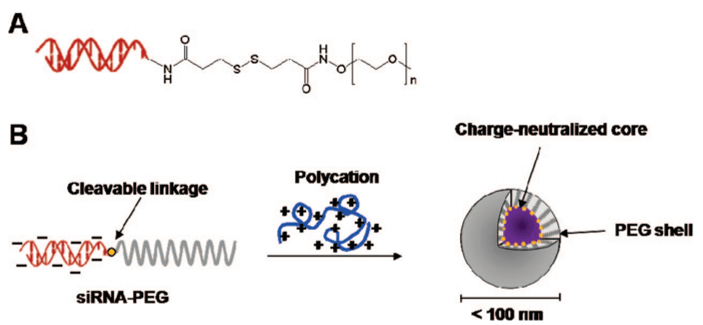 Figure1: A. Structure of PEG-siRNA conjugate; B. Formation of PEC micelles from the interactions between PEG-siRNA conjugate and a polycation (Jeong, J. H. 2009).
Polymer conjugation significantly enhances siRNA stability, extends circulation half-life, improves cellular uptake efficiency, and enables targeted delivery through customizable polymer properties and functional groups.
PEG conjugation reduces immune recognition, increases solubility, enhances thermal stability, and prolongs functional activity by protecting against nuclease degradation and rapid clearance.
Multiple polymer options include polyethylene glycol (PEG), polyethyleneimine (PEI), chitosan, cyclodextrin, dendrimers, and biodegradable polymers like PLGA, each offering distinct advantages for specific research needs.
Rigorous quality control includes HPLC for purity analysis, gel electrophoresis for integrity verification, mass spectrometry for molecular weight confirmation, and functional validation in biological systems.


References:
 Loading ......